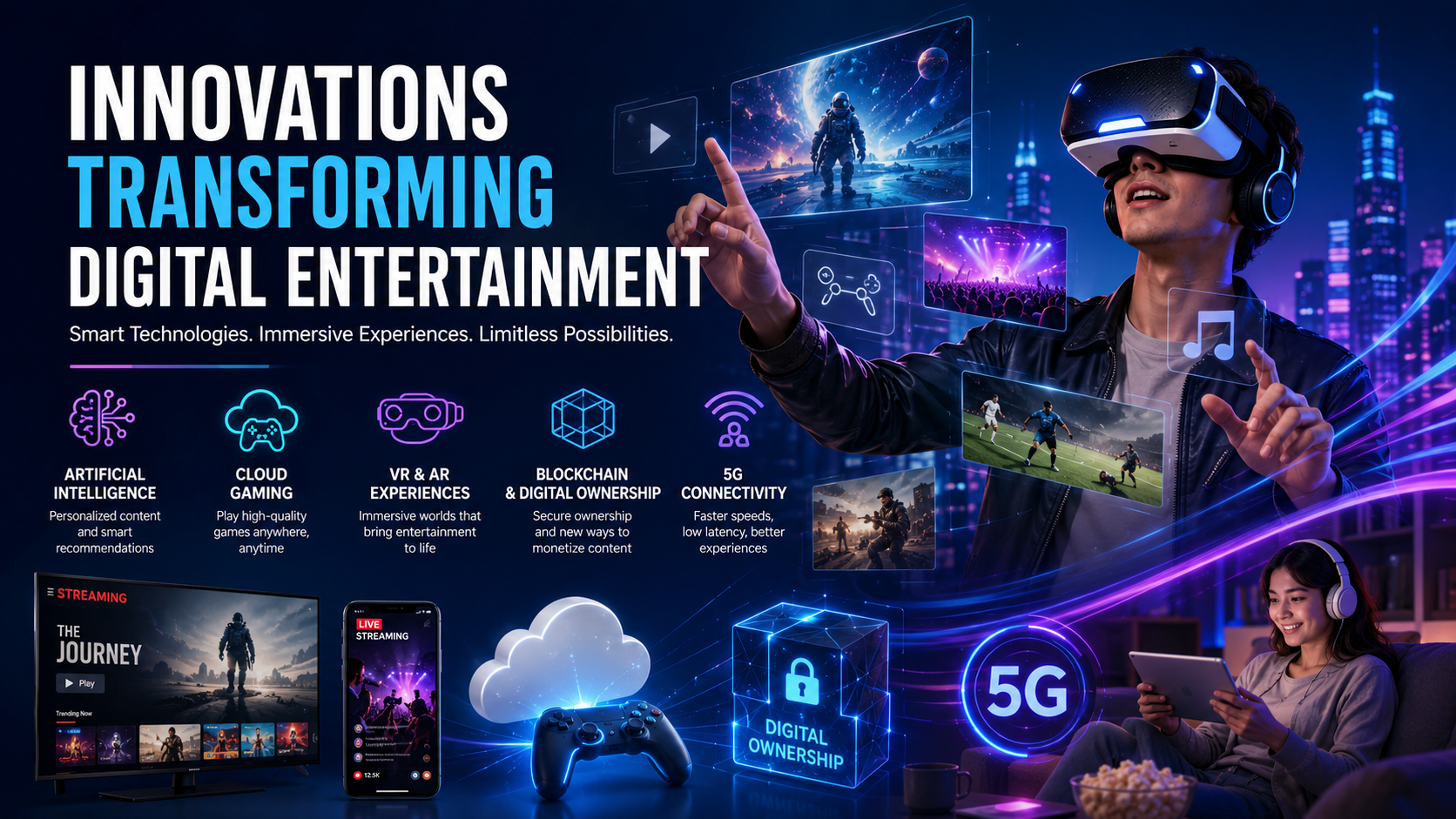
Innovations Transforming Digital Entertainment
Digital entertainment has evolved at an extraordinary pace over the last decade. What once revolved around traditional television, movie theaters, and physical gaming consoles has transformed into a connected ecosystem powered by advanced technologies. Today, audiences expect personalized experiences, instant access to content, and immersive forms of engagement that go far beyond passive consumption.
From artificial intelligence and cloud gaming to virtual reality and interactive streaming, innovation is redefining how people watch, play, listen, and interact with entertainment. As technology continues to advance, the digital entertainment industry is becoming more dynamic, accessible, and engaging than ever before.
This article explores the key innovations transforming digital entertainment and how they are shaping the future of media consumption worldwide.
Artificial Intelligence Is Personalizing Entertainment
Artificial intelligence (AI) has become one of the most influential technologies in modern entertainment. Streaming platforms, gaming companies, and content creators use AI to understand audience preferences and deliver personalized experiences.
Services like Netflix and Spotify rely on sophisticated recommendation algorithms to suggest content based on viewing and listening habits. This personalization improves user engagement by helping audiences discover relevant content more quickly.
AI is also being used in content production. Filmmakers and media companies leverage machine learning tools to analyze audience behavior, predict trends, and optimize content strategies. According to research from the World Economic Forum, AI is expected to play an increasingly important role in content creation, distribution, and audience engagement over the coming years.
The Rise of Cloud Gaming
Cloud gaming is transforming the video game industry by removing hardware limitations. Instead of requiring expensive gaming consoles or high-performance PCs, cloud gaming platforms stream games directly over the internet.
This technology allows players to access high-quality gaming experiences on smartphones, tablets, laptops, and smart TVs. As internet infrastructure continues to improve globally, cloud gaming is making premium gaming more accessible to a wider audience.
Major technology companies are investing heavily in cloud-based gaming solutions because they offer convenience, scalability, and lower entry barriers for consumers. This shift is helping gaming reach new demographics that previously lacked access to advanced gaming hardware.
Virtual Reality and Augmented Reality Are Creating Immersive Experiences
Virtual Reality (VR) and Augmented Reality (AR) are redefining audience engagement by creating immersive digital environments.
VR technology enables users to step inside virtual worlds, making entertainment more interactive and realistic. Whether it’s gaming, virtual concerts, sports simulations, or cinematic experiences, VR offers a level of immersion that traditional screens cannot match.
AR, meanwhile, blends digital content with the real world. Popular mobile applications and interactive experiences use AR to enhance user engagement through real-time visual overlays.
Organizations such as the Institute of Electrical and Electronics Engineers (IEEE) continue to highlight the growing role of immersive technologies across entertainment, education, and communication industries.
Streaming Platforms Continue to Evolve
Streaming has fundamentally changed how audiences consume entertainment. Viewers no longer rely on fixed schedules or physical media to access their favorite content.
Modern streaming platforms are introducing new features that improve user experience, including:
- Interactive storytelling
- Live streaming integration
- Multi-device synchronization
- Personalized content recommendations
- Real-time audience participation
The growing popularity of subscription-based and ad-supported streaming models demonstrates how consumer preferences are shifting toward flexible, on-demand entertainment options.
As competition increases among platforms, innovation remains essential for attracting and retaining audiences.
The Expansion of Interactive Entertainment
Today’s audiences increasingly prefer participation over passive viewing. This trend has fueled the growth of interactive entertainment formats.
Interactive movies, live-streaming communities, esports, and social gaming experiences allow users to influence outcomes, communicate with creators, and engage with other participants in real time.
Platforms such as Twitch have demonstrated how community-driven entertainment can become a major industry segment. Interactive engagement creates stronger emotional connections between audiences and content creators, driving higher levels of loyalty and participation.
The rise of user-generated content is also contributing to this transformation, allowing individuals to become creators rather than simply consumers.
Blockchain and Digital Ownership
Blockchain technology is introducing new concepts of ownership and monetization within digital entertainment.
Creators can use blockchain-based systems to establish transparent ownership rights, while consumers gain access to verifiable digital assets. These innovations have opened discussions around digital collectibles, virtual economies, and new methods of content distribution.
Although blockchain adoption in entertainment is still developing, many industry experts believe it has the potential to reshape how digital assets are managed, traded, and monetized in the future.
5G Connectivity Is Accelerating Innovation
The global rollout of 5G networks is providing the infrastructure needed to support next-generation entertainment experiences.
Faster speeds and lower latency improve the performance of:
- Cloud gaming
- High-definition streaming
- Virtual reality experiences
- Augmented reality applications
- Live interactive broadcasts
Enhanced connectivity allows entertainment providers to deliver richer experiences with fewer technical limitations. As 5G coverage expands, users can expect smoother, more responsive digital entertainment services across multiple devices.
The Future of Digital Entertainment
Digital entertainment is moving toward a future defined by personalization, immersion, and accessibility. Emerging technologies are creating opportunities for more engaging experiences while giving creators new tools to reach global audiences.
Artificial intelligence will continue improving content discovery, cloud technology will expand accessibility, and immersive platforms will blur the line between physical and digital experiences.
Companies that successfully combine innovation with user-focused design will be best positioned to lead the next phase of entertainment evolution.
Final Thoughts
Innovations transforming digital entertainment are reshaping the way people consume media, interact with content, and engage with creators. Artificial intelligence, cloud gaming, immersive technologies, blockchain, and advanced connectivity are driving a new era of entertainment that prioritizes convenience, personalization, and interactivity.
As these technologies continue to mature, digital entertainment will become even more immersive and accessible. For consumers, this means richer experiences and greater choice. For creators and businesses, it presents exciting opportunities to innovate, connect with audiences, and redefine the future of entertainment.
FAQs
What is digital entertainment?
Digital entertainment refers to media and entertainment content delivered through digital technologies, including streaming platforms, online gaming, virtual reality experiences, podcasts, and social media content.
How is AI changing the entertainment industry?
AI helps personalize content recommendations, analyze audience preferences, automate production tasks, and improve user engagement across entertainment platforms.
What is cloud gaming?
Cloud gaming allows users to stream video games over the internet without needing powerful local hardware, making gaming more accessible across different devices.
Why are VR and AR important in entertainment?
VR and AR create immersive experiences that increase audience engagement by allowing users to interact with digital content in more realistic and interactive ways.
How does 5G impact digital entertainment?
5G provides faster internet speeds and lower latency, improving streaming quality, cloud gaming performance, virtual reality experiences, and live interactive content.
What role does blockchain play in entertainment?
Blockchain can support digital ownership, transparent rights management, secure transactions, and new monetization models for creators and consumers.
Leave a Reply