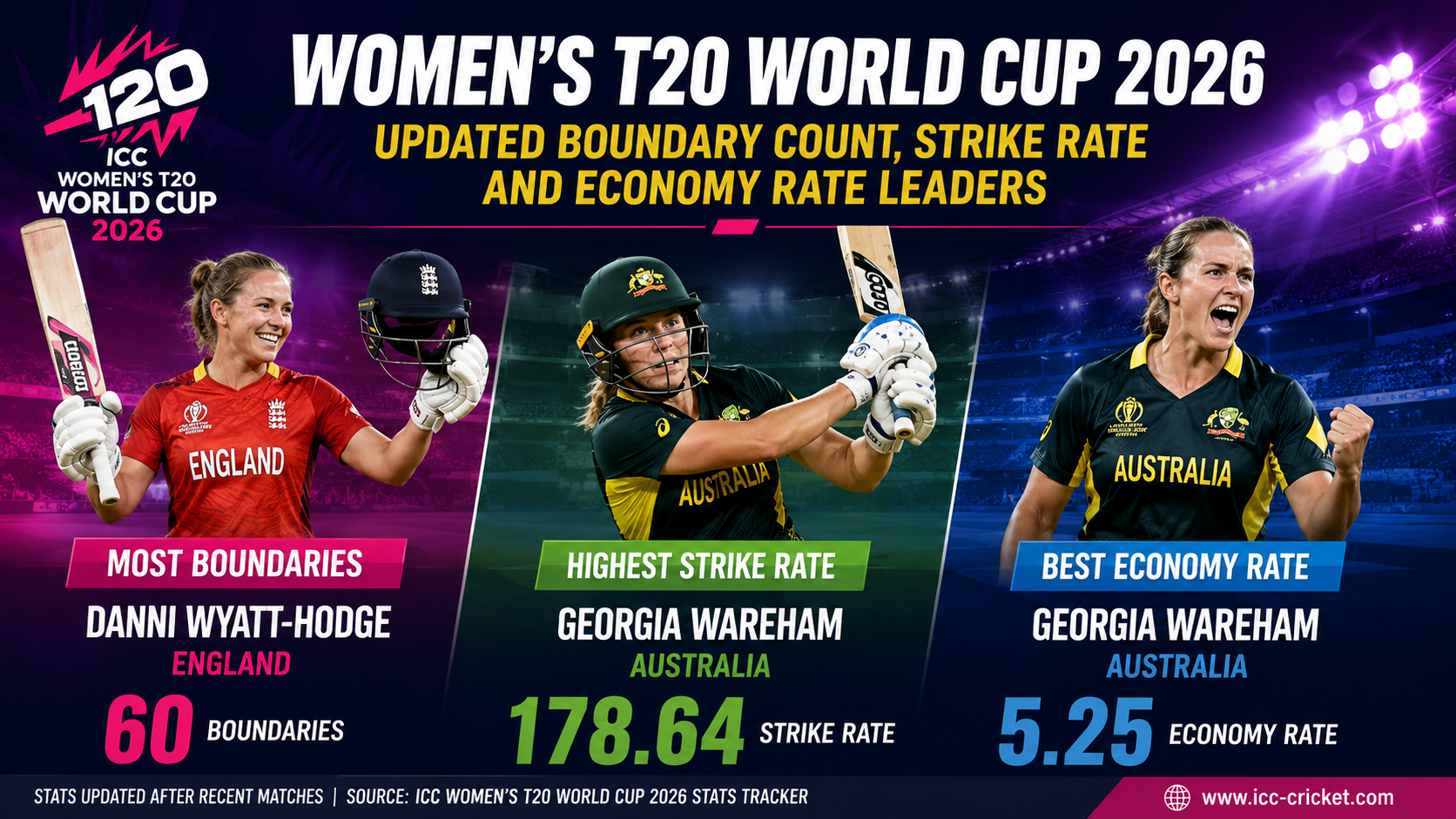
Women’s T20 World Cup 2026: Updated Boundary Count, Strike Rate and Economy Rate Leaders
The ICC Women’s T20 World Cup 2026 has delivered outstanding individual performances alongside thrilling team contests. While runs and wickets often dominate headlines, advanced statistics such as boundary count, batting strike rate, and bowling economy rate provide a deeper understanding of which players have truly influenced matches.
These metrics highlight aggressive batting, efficient scoring, and disciplined bowling—three qualities that separate good performances from tournament-defining ones. As the competition reaches its final stages, the latest statistical leaders reveal who has consistently performed under pressure. Official tournament statistics continue to evolve after every match, making these categories among the most closely watched by fans and analysts.
Why These Statistics Matter
Traditional batting averages and wicket tallies only tell part of the story. Modern T20 cricket demands players who can score quickly and bowl economically.
The three major performance indicators are:
- Boundary Count: Measures attacking intent and the ability to find gaps or clear the ropes.
- Strike Rate: Shows how rapidly a batter scores, often determining momentum.
- Economy Rate: Reflects how effectively a bowler controls scoring during limited overs.
Together, these numbers paint a more complete picture of player impact throughout the tournament.
Boundary Count Leaders Continue to Dominate
The tournament’s leading boundary hitters have consistently provided explosive starts and maintained pressure on opposition bowlers.
England opener Danni Wyatt-Hodge has emerged as one of the biggest attacking forces, combining elegant stroke play with aggressive intent. Her ability to regularly find the boundary has helped England post competitive totals throughout the tournament. She also leads the run-scoring charts after another impressive campaign.
South Africa’s Tazmin Brits has also impressed with powerful hitting, particularly during the powerplay, while Australia’s experienced batters have maintained an excellent balance between timing and controlled aggression.
Boundary statistics often reveal which batters force bowling changes and disrupt field placements—an invaluable advantage in T20 cricket.
Strike Rate Leaders Show Modern T20 Excellence
Batting strike rate has become one of the most important statistics in modern cricket.
A batter scoring at 170 or 180 runs per 100 balls can completely alter a match within a few overs.
Australia’s Georgia Wareham has been among the tournament’s most explosive performers despite batting lower down the order. Her strike rate has remained among the highest in the competition, proving how valuable quick cameos can be in the closing overs.
England’s middle-order hitters have also maintained impressive scoring rates, while India’s finishers have shown their ability to accelerate against both pace and spin.
High strike rates indicate more than just aggressive batting—they demonstrate smart shot selection, excellent game awareness, and confidence under pressure.
Economy Rate Leaders Have Controlled Matches
While batters often receive most of the attention, disciplined bowling wins championships.
The best economy rates in the Women’s T20 World Cup 2026 belong to bowlers who consistently limit scoring opportunities while forcing mistakes.
Australia’s bowling attack has once again showcased remarkable control, with spinners and seamers working together to keep opposition scoring rates under check. Georgia Wareham has been particularly effective, combining wicket-taking ability with one of the tournament’s lowest economy rates.
England’s pace attack has also maintained excellent control during middle overs, while several emerging bowlers from associate nations have impressed by keeping experienced batting line-ups quiet.
In T20 cricket, conceding just five or six runs per over can completely shift momentum.
Australia and England Continue to Set the Standard
Statistical leaders often come from teams performing well collectively.
Australia’s unbeaten campaign has been built on aggressive batting, disciplined bowling, and outstanding fielding. Their players feature prominently across multiple statistical categories, demonstrating the squad’s remarkable depth. Australia eventually claimed another Women’s T20 World Cup title after defeating England in the final.
England also produced several standout performers throughout the tournament, especially with the bat. Their attacking approach helped multiple players climb the strike-rate and boundary charts.
These numbers highlight why both teams consistently remain among the world’s strongest T20 sides.
Emerging Players Making Their Mark
One of the most encouraging aspects of the tournament has been the emergence of young talent.
Several players from Scotland, South Africa, Sri Lanka, and other developing cricket nations have broken into the tournament’s statistical leaderboards, proving that women’s cricket continues to become more competitive globally.
Strong performances in categories like strike rate and economy rate demonstrate that newer teams are narrowing the gap against traditional powerhouses.
That growing depth promises an exciting future for international women’s cricket.
What the Numbers Reveal About Modern Women’s T20 Cricket
Looking beyond individual performances, the statistics reveal several broader trends:
- Batters are attacking earlier during the powerplay.
- Teams are prioritising boundary scoring over strike rotation.
- Bowling units rely more heavily on variations and slower deliveries.
- Spinners continue to dominate middle overs through accuracy rather than excessive turn.
- Lower-order batters are contributing at much higher strike rates than in previous tournaments.
These developments reflect how women’s T20 cricket continues to evolve strategically every year.
FAQs
Who leads the Women’s T20 World Cup 2026 run-scoring charts?
England’s Danni Wyatt-Hodge has been among the tournament’s leading run scorers following a series of outstanding innings.
Why is strike rate so important in T20 cricket?
Strike rate measures scoring speed. A higher strike rate helps teams maximise limited overs and build match-winning totals quickly.
What is considered a good economy rate in Women’s T20 cricket?
Generally, an economy rate below 6.5 runs per over is considered excellent, especially against strong batting teams.
Which team has shown the best overall balance in the tournament?
Australia has demonstrated the strongest combination of explosive batting, disciplined bowling, and consistent fielding throughout the competition.
Where can fans check the latest tournament statistics?
Fans can follow the official ICC Women’s T20 World Cup Stats Tracker and official match results pages, which update after every completed match.
Final Thought
The Women’s T20 World Cup 2026 has highlighted just how much the women’s game has evolved. Boundary hitters are changing matches in a matter of overs, high strike-rate batters are redefining finishing roles, and disciplined bowlers continue to prove that control is just as valuable as wickets. As the tournament progressed, these advanced statistics became more than numbers—they reflected tactical excellence, consistency, and the ability to perform under pressure. Whether following the race for the most boundaries, the fastest scoring rates, or the most economical bowling spells, these leaderboards showcase the players shaping the future of international women’s T20 cricket.
Leave a Reply